
TLDR
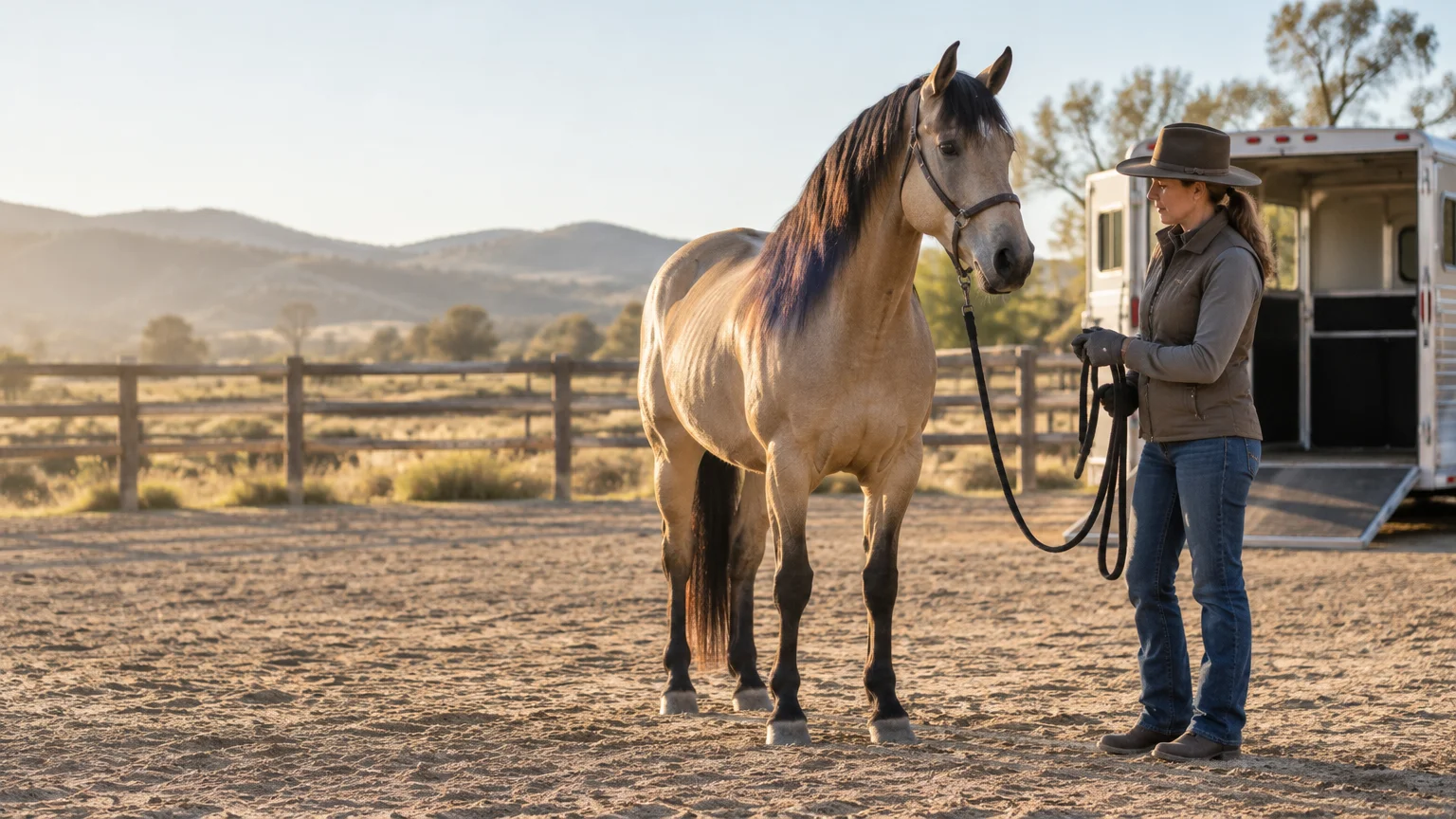
Effective horse trailer loading groundwork begins away from the trailer. Teach the horse to follow a light forward cue, halt and wait, back slowly, move the shoulders and hindquarters, cross changes in footing, and pass through a defined lane. Once those skills are quiet and repeatable, introduce a prepared, parked trailer in small stages. Do not make “completely loaded” the measure of every session. One calm approach, one foot at the threshold, or one unhurried exit may be the right success for the day.
Trailer loading is not one behavior. It is a chain of familiar responses performed beside and inside an unfamiliar confined space. Good horse trailer loading groundwork teaches each link separately, so the handler does not have to solve leading, straightness, patience, backing, and fear all at once on travel day.
A horse that stops at a ramp or step-up is not necessarily being defiant. The footing, light, echoes, partition movement, narrow entrance, or memory of an earlier trip may have changed the question. The practical answer is to identify the missing skill, improve the trailer environment, and lower the difficulty until the horse can think and respond again.
The seven horse trailer loading groundwork skills
A review of transport-related problem behavior recommends preparing the handling components of loading—including leading, backing, sideways movement, and tying—before progressing through loading simulations, standing in the vehicle, unloading, and short journeys. The full review is available through the transport-behavior review in PMC.
| Foundation | What quiet competence looks like | Why it matters at the trailer |
|---|---|---|
| Light forward response | The horse follows a modest lead cue without being dragged or rushing past the handler. | Loading begins with a willing forward step, not a pulling contest. |
| Halt and stand | The horse stops from the lead and waits briefly without crowding or swinging away. | Pauses let the handler manage doors, partitions, and position without hurry. |
| Slow, straight backing | The horse takes one or several deliberate backward steps while staying reasonably aligned. | Most horses must unload backward, often across a threshold or down a ramp. |
| Shoulder yield | The front end can step left or right from a clear, light request. | The handler can correct drift before a shoulder meets a wall or partition. |
| Hindquarter yield | The hindquarters can move over without the horse surging forward. | This helps restore alignment during approaches and other routine handling. |
| Footing confidence | The horse can investigate and cross safe changes in color, texture, or sound. | Trailer floors, mats, ramps, and shadows can look and feel different from the surrounding ground. |
| A wide visual lane | The horse can walk between poles, rails, cones, or safe solid boundaries without feeling trapped. | A lane rehearses straightness and narrowing space without immediately adding the trailer. |
These exercises should not become tests of obedience. Look for a soft, prompt attempt followed by a release, pause, or other reward the horse understands. If the horse braces, swings, or accelerates, simplify the request. A single balanced step is more useful than several hurried steps that merely carry the horse through the exercise.
1. Install the responses away from the trailer
Begin in a familiar enclosed working area with safe footing. Ask for a few steps of leading, a halt, and a short wait. Then practice one backward step, forward again, and gentle repositioning of the shoulders and hindquarters. Keep enough space that neither horse nor handler feels hemmed in.
For the forward response, apply the light cue the horse already knows and give it time to answer. Reward the first genuine step by softening immediately. Avoid maintaining a heavy pull, which can invite the horse to brace against the rope. The goal is not to tow the head forward; it is to establish that a clear cue leads to a voluntary step.
Backing deserves special attention because an otherwise willing horse may enter and then rush out. Start with one slow step on level ground. Reward the moment the horse shifts weight back and moves a foot without throwing its head up or leaning on the rope. Build to several straight steps only after the first step stays organized.
2. Rehearse the shape of loading without the trailer
Create a generous lane using objects that cannot trap a leg or roll underfoot. Walk through, halt inside, wait, and back out. Gradually make the lane more defined, but never so tight that the horse is squeezed between hazards. This is a simulation of direction and boundaries, not an attempt to manufacture fear.
Safe footing transitions can be introduced just as gradually. Let the horse inspect a secure mat or another non-slip surface before crossing it. Do not use loose tarps, unstable platforms, or improvised obstacles that can slide, wrap around a leg, or turn a confidence exercise into an accident.
3. Prepare the trailer before bringing the horse over
A training problem can actually be an equipment or environment problem. Park the hitched trailer on firm, level ground where there is room to approach and retreat. Remove loose equipment and other obstacles, secure partitions and doors, provide ventilation, and inspect the floor and mats. Extension Horses also advises using a properly fitted halter and lead rope, leading by the rope rather than gripping the halter, and never wrapping the rope around a hand.
Perform the mechanical inspection separately from the training session. The horse trailer pre-trip checklist provides a repeatable review of the tow vehicle, hitch, horse compartment, documents, and emergency equipment. During groundwork, the trailer should already be stable and ready so rattling hardware or last-minute adjustments do not surprise the horse.
- Use a sound trailer that suits the horse’s size and intended position.
- Check the floor, mats, ramp or step, partitions, latches, and ventilation.
- Secure anything that could swing, fall, or strike the horse.
- Clear people, dogs, buckets, and equipment from the approach and exit path.
- Wear suitable footwear and gloves, and use a properly fitted halter and serviceable lead.
- Keep the lead rope organized; never coil or wrap it around your hand or body.
- Do not stand directly behind the horse or place yourself where a door, wall, or partition could pin you.
4. Treat the approach and threshold as separate lessons
Walk toward the trailer only as far as the horse can remain attentive. Halt, wait, and leave again. On another repetition, approach closer. Let the horse look and investigate without allowing it to push into the handler or spin away uncontrolled. Curiosity is useful, but it still needs safe boundaries.
At the threshold, reward observable pieces of progress: looking into the trailer, lowering the head to inspect the floor, standing square, shifting weight forward, or placing one foot calmly. If the horse becomes more worried with every repetition, the criterion is too high. Step away, recover an easy known response, and finish or try a simpler approach.
Different reinforcement methods can support this process. With well-timed pressure and release, the handler presents a light directional cue and releases when the horse makes the requested effort. Target training can give the horse a clear object to approach, while food reinforcement requires thoughtful delivery and manners around food. A small study involving five Quarter Horse mares with aversive loading histories found that target training and shaping were associated with completing the loading sequence and reducing problem behavior in that setting. Its small sample should not be treated as proof that one method works for every horse.
5. Practice standing and unloading, not just entering
A horse is not fully prepared merely because all four feet crossed the threshold. Standing quietly and leaving under control are distinct parts of the sequence. At first, the horse may enter only partway and back out. Later, it can stand briefly inside before unloading. Increase duration in small increments rather than closing every divider and door at the first successful entry.
Use the backing foundation established away from the trailer. Ask for one step, pause, and ask again. Keep the horse straight enough to avoid stepping off the side of a ramp or catching a hip. The handler’s safe position depends on the trailer configuration, so do not improvise in a narrow space where you could be pinned. Get experienced in-person help if you cannot direct the exit without entering a dangerous position.
Reliability can change with a different trailer, location, configuration, or stressed handler, which is why departure day should not be the horse’s only practice. Once loading, standing, and unloading are calm in a parked trailer, repeat them occasionally under safe but slightly varied conditions. Short, uneventful journeys can follow when the horse and equipment are ready, as part of the gradual progression described in transport-behavior guidance.
Troubleshoot the missing piece instead of escalating
| What you see | What it may tell you | Safer response |
|---|---|---|
| The horse plants before the entrance | The forward cue may be weak, or the horse may be worried by footing, darkness, noise, or confinement. | Check the trailer and footing, then retreat to a distance where a light forward response still works. |
| The shoulders drift sideways | Straightness or shoulder control is missing, or the approach feels too narrow. | Widen the approach and rehearse shoulder yields and lane work away from the trailer. |
| The horse rushes backward | Backing has not been broken into slow steps, or anxiety rises while standing inside. | Practice one-step backing elsewhere and shorten the time inside. Do not try to stop a panicked horse through brute force. |
| The horse enters but will not stand | Entry was taught, but duration and confinement were increased too quickly. | Reward a brief pause, unload calmly, and build standing time over multiple sessions. |
| The horse becomes more agitated | The task has exceeded the horse’s ability to stay responsive. | Lower the criterion or stop. Repeated escalation is not productive habituation. |
| The horse rears, strikes, scrambles, falls, or bolts backward | The situation presents an immediate injury risk and may involve severe fear, pain, prior trauma, or unsuitable equipment. | End the do-it-yourself session and seek qualified in-person help plus veterinary assessment when health may be involved. |
When groundwork is not enough
Stop treating the issue as an ordinary training gap when there is a sudden change in behavior, suspected pain, impaired vision, poor balance, or difficulty stepping up and backing in other settings. A veterinarian can help investigate physical causes. A qualified trainer experienced with trailer loading can assess handling, trailer fit, timing, and safe positions in person.
Rearing, striking, crushing the handler against the trailer, scrambling, falling, or bolting backward are not suitable problems for trial-and-error instruction from an article. The immediate objective is preventing injury, not winning the session. Sedation and other medical interventions are veterinary decisions; they are not substitutes for teaching the component skills needed for future trips.
A simple first session
Set aside 15 or 20 unhurried minutes on a day when the horse does not need to travel. Check the trailer first, then bring the horse into the general area. Review leading, halt, one backward step, and a small shoulder adjustment. Approach until the horse notices the trailer but can still answer an easy cue. Pause, retreat, and repeat only while the horse remains settled.
A successful first session might end without a hoof entering the trailer. If the horse approached more willingly, stood square at a comfortable distance, and backed away without rushing, you improved several parts of the eventual loading sequence. Return another day and build from that quiet result.
Before an actual interstate trip, check the destination’s current animal-movement rules. APHIS notes that horses moving interstate commonly need individual identification and a Certificate of Veterinary Inspection, but the requirements should be confirmed for the specific destination and journey.
Make calm repetition the next step
Schedule one non-travel-day practice rather than waiting for an appointment or evacuation. Choose the weakest foundation—forward, halt, backing, straightness, footing, or standing—and improve that one piece. End after an achievable, quiet repetition. Over time, the trailer becomes less of a single intimidating obstacle and more of a familiar sequence the horse already knows how to perform.
References
- How to minimise the incidence of transport-related problem behaviours in horses: a review – PMC
- Safe Loading Practices for Horses | Extension Horses
- Loading the problem loader: the effects of target training and shaping on trailer-loading behavior of horses – PubMed
- How to Handle Horse Trailering Emergencies – The Horse
- Interstate Movement of Cattle, Horses, Swine, Sheep & Goats | APHIS