
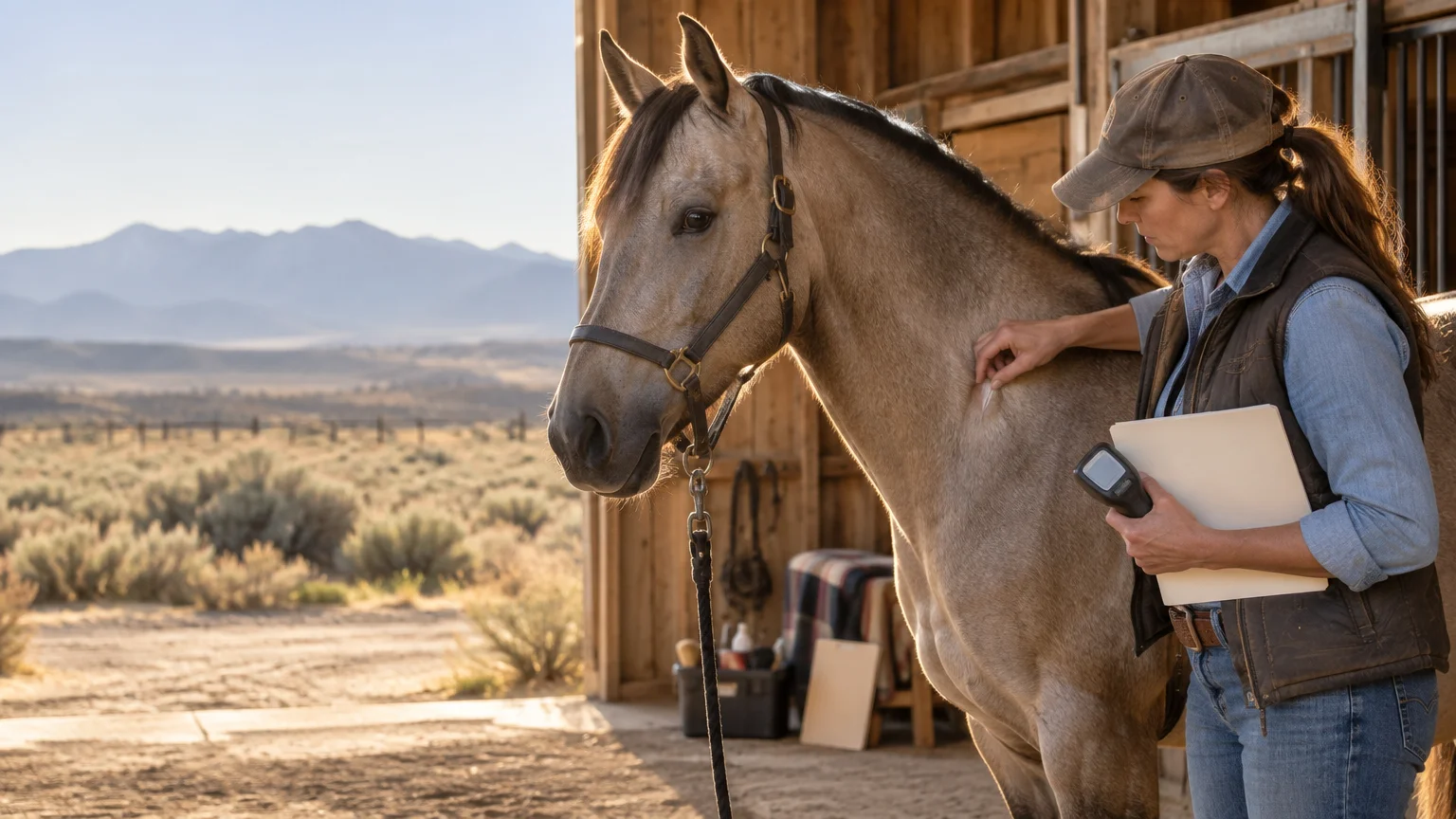
TLDR: A dependable horse identification file has several layers. Record the exact microchip number after a professional scan, take clear and dated photographs, write a detailed signalment, document brands and other permanent markings, and keep the associated ownership, registry, adoption, and transfer papers together. Store both physical and backed-up digital copies.
If your working checklist begins with “horse identification records microchip photos,” the most important principle is that no single item should stand alone. A chip supplies an electronic identifier. Photographs show the horse at a particular time. A written description captures details that may be hard to see in an image. Papers connect those identifiers to an ownership trail, registry, agency, or known history.
That layered approach matters especially for Sulphur horses, Colonial Spanish horses, Mustangs, and other heritage animals whose records may pass through adopters, private owners, breeders, registries, and conservation projects. Good identification protects more than a transaction. It preserves useful history about an individual horse.
The five layers of a strong horse identification record
| Record layer | What to capture | What it contributes | Main limitation |
|---|---|---|---|
| Electronic identification | Exact microchip number, scan date, scanner or clinic, and associated database, agency, or registry if known | A durable machine-readable identifier | The number alone does not explain ownership, pedigree, or history |
| Identification photographs | Full-body views and close-ups of permanent or distinctive features | A visual comparison with the horse standing in front of you | Appearance, coat shade, hair length, and scars can change |
| Written signalment | Sex, age, color, markings, whorls, scars, brands, tattoos, and other identifiers | Searchable details that remain useful when photographs are unclear | Descriptions can be incomplete or use inconsistent terminology |
| Supporting papers | Bill of sale, registration certificate, adoption and title papers, transfer forms, and relevant veterinary documents | Connects the physical horse to its recorded history | Papers can be lost, outdated, or separated from the horse |
| Redundant storage | Paper folder, backed-up digital files, and a current summary sheet | Keeps the record usable after a lost phone, damaged file, or ownership transfer | Copies must be updated when information changes |
USDA APHIS describes electronic identification, written descriptions, photographs, markings, brands, tattoos, scars, and whorls as complementary ways to identify equines. Its equine identification reference is useful background when deciding what belongs in a durable file.
Record the microchip as verified information
Do not copy a microchip number from an old certificate and assume that it belongs to the horse. Ask an equine veterinarian, clinic, registry representative, or other qualified operator to scan the horse, then record the number exactly as displayed. Transposed digits can make an otherwise sound record nearly useless.
For equids, the recognized implantation location is the left nuchal ligament in the middle portion of the neck. The American Association of Equine Practitioners supports ISO 11784/11785-compliant radio-frequency identification technology for equids. If an initial scan finds nothing, ask for a careful rescan over a broader area rather than immediately concluding that the horse has no chip. The original implant site, scanner compatibility, migration, or incomplete earlier records may require a more methodical check.
Microchip details to save
- The complete number exactly as it appears on the scanner
- The date and place of the scan
- The veterinarian, clinic, agency, or other operator who performed it
- The scanner type or scan report, if provided
- The chip manufacturer or format, if known
- Any registry, agency, or database associated with the number
- A copy of the certificate, implant record, or registration page showing the number
- Notes about an unsuccessful scan or a discrepancy with earlier paperwork
A chip is an identifier, not a self-contained biography. A number may be connected to a registry, agency, private database, veterinary record, or no accessible owner record at all. It does not by itself establish pedigree, current ownership, health history, or registration status. Those conclusions depend on the records legitimately connected to the identifier.
Take horse identification photos for comparison, not beauty
Good identification photographs are plain, sharp, and repeatable. Stand the horse on level ground in open shade or soft daylight. Remove blankets, boots, and tack that hide the body or legs. Keep the horse reasonably square, avoid dramatic camera angles, and fill the frame without cutting off the ears, hooves, or tail.
The following is a practical owner checklist rather than a universal registry or legal standard. A specific registry, insurer, agency, laboratory, or transport authority may require different views or file formats.
- Full left profile, showing the entire horse
- Full right profile
- Straight front view, including the face and both forelegs
- Straight rear view, including both hind legs
- Clear head view with facial markings visible
- Close-up of each white leg marking, including the hoof when useful
- Close-ups of scars, brands, tattoos, freeze marks, or unusual patches
- Views of distinctive whorls on the face, neck, chest, or body
- Close-ups of primitive markings such as a dorsal stripe, leg barring, shoulder shading, or cobwebbing when relevant
- One image containing a dated card or case number, provided it does not obscure the horse
Keep the original image files when possible because they preserve more detail than screenshots or compressed social-media copies. Rename files consistently, such as “HorseName_left-profile_2026-03-15.” Never replace every older image with the newest set. Dated photographs can show continuity as a young horse matures, a winter coat changes color, or a scar becomes less conspicuous.
For additional guidance specific to Sulphur Mustang features and ownership history, see how to document a Sulphur Mustang’s markings and records.
Write a signalment that works without the pictures
A signalment is a structured written description of an animal. For an identification file, begin with the horse’s recorded name and any former names, sex, known or approximate birth date, breed or type, height if measured, and base color. Then describe permanent or relatively stable identifiers in a consistent order.
- Facial markings, including their shape and where they begin and end
- White leg markings, described separately for each leg
- Whorls and their exact locations
- Brands, tattoos, and freeze marks, transcribed carefully
- Scars, including approximate size, shape, and location
- Unusual hoof coloration or other lasting features
- Microchip number and the date it was last verified
- Any conflict between the present description and an older record
APHIS instructions for official equine documentation call for identifying features such as markings, brands, tattoos, scars, and whorls, along with relevant microchip or registration information. That does not make one form the standard for every private record, but it demonstrates why a written description still matters beside photographs.
Use neutral language and enough anatomical detail that another person could locate the feature. “Small scar” is weak. “Approximately two-inch curved scar on the outside of the right hind cannon” is more useful. For a whorl, note whether it lies above, between, or below the eyes rather than merely writing “face whorl.”
Document brands, tattoos, and BLM freeze marks carefully
Photograph every permanent mark straight on and from close enough to preserve its shape. Then transcribe what you see without guessing at uncertain characters. Record the body location and the date photographed. A second image from farther away helps establish that the close-up belongs to the documented horse.
BLM states that wild horses and burros removed from public lands receive a freeze mark on the left side of the neck and a microchip. Its resources may use those identifiers to return selected information about an animal’s history. BLM also notes that a signalment can assist identification when the freeze mark cannot be read and no microchip is available.
For a BLM horse, retain the adoption agreement, title documents, transfer records, facility or event paperwork, freeze-mark transcription, and microchip record. Use the Bureau of Land Management freeze-mark information rather than relying on memory or an unofficial interpretation. If the mark is faint, clip or clean the area only when it is safe and appropriate for the horse, and use angled natural light to make the characters easier to photograph.
Keep identity, pedigree, ownership, and health records distinct
These records support one another, but they answer different questions. Identity asks, “Is this the same horse?” Pedigree asks, “Who are the recorded ancestors?” Ownership records show how legal possession or title was transferred. Registration describes status within a particular organization. Veterinary records document care, tests, treatment, or health certification.
A horse may be unmistakably identified without having a documented pedigree. It may have registration papers without a complete chain of current ownership documents. A bill of sale may show a transaction without proving that every pedigree statement in an advertisement is correct. Keeping those categories separate makes the file more credible and makes gaps easier to investigate. Readers considering breed paperwork can also review why horse registration matters.
What to do when the horse and paperwork do not match
Treat a mismatch as a reason to pause, not as an invitation to make the record fit. During a purchase, adoption transfer, insurance claim, or registration project, compare the scanned microchip, physical markings, photographs, written signalment, and original documents before proceeding.
- Write down the discrepancy precisely. Do not rely on a verbal summary.
- Scan the horse again and confirm every digit shown.
- Compare permanent markings rather than coat shade alone.
- Ask for original documents and dated earlier photographs.
- Contact the issuing registry, agency, veterinarian, or recordkeeper through its official channel.
- Use an authorized DNA or parentage process when a registry offers one and pedigree is at issue.
- Do not alter a chip number, mark description, certificate, or transfer date to remove the conflict.
A mismatch can arise from a copying error, an outdated photograph, an unrecorded transfer, confusion between similar horses, or a more serious documentation problem. The cause should be established by the appropriate recordkeeper rather than assumed by a buyer or seller.
Prepare a travel copy without confusing it with compliance
Keep a concise travel packet containing the horse’s identification summary, current photographs, chip number, emergency contacts, and copies of relevant ownership and health papers. That packet can help a veterinarian, transporter, facility manager, or animal-health official compare the traveler with the documents presented.
It does not replace current travel requirements. U.S. interstate identification rules include exceptions and recognize different methods in different circumstances, which may include written descriptions, ISO-compliant electronic identification, certain existing identification, or sufficient digital photographs. Destination requirements can also vary. Confirm the current rules with an accredited veterinarian and the animal-health authority for the destination before departure.
A simple record-building session
Consider a mature Sulphur mare with a dorsal stripe, leg barring, a small forehead star, one white hind pastern, and an old scar near the left shoulder. Her owner schedules a chip scan and records the displayed number, date, and clinic. On the same day, the owner takes four full-body views, a headshot, leg photographs, and close-ups of the scar and primitive markings.
The owner then completes a one-page signalment, attaches copies of the bill of sale and available registration or transfer papers, and notes that the mare’s winter coat makes the leg barring less distinct than it appears in summer photographs. The complete folder is scanned to a backed-up digital location, while the original papers remain in a protected physical file. That record does not answer every pedigree question, but it creates a defensible link among the living horse, her identifiers, and her known paperwork.
Build the file now, then maintain it
The best next step is a short documentation appointment: arrange a microchip scan, take the complete photo set, and finish a one-page signalment on the same day. Add the supporting papers, save a digital backup, and place a review date on the folder.
Update photographs after a major appearance change, when a new permanent scar or mark develops, before a sale or transfer, and whenever a registry, insurer, transporter, or agency requests current images. Verify the chip again when identity is especially consequential. Patient recordkeeping may feel ordinary, but for a heritage horse it preserves something valuable: a reliable connection between the individual standing in the pasture and the history carried forward in that horse’s name.
References
- NVAP Reference Guide: Equine Identification | APHIS
- Position on Microchips for the Identification of Equids – AAEP
- Instructions for completing VS Form 10-11 (version FEB 2018) | APHIS
- Freeze Marks | Bureau of Land Management
- 9 CFR § 86.4 – Official identification. | Electronic Code of Federal Regulations (e-CFR) | US Law | LII / Legal Information Institute