
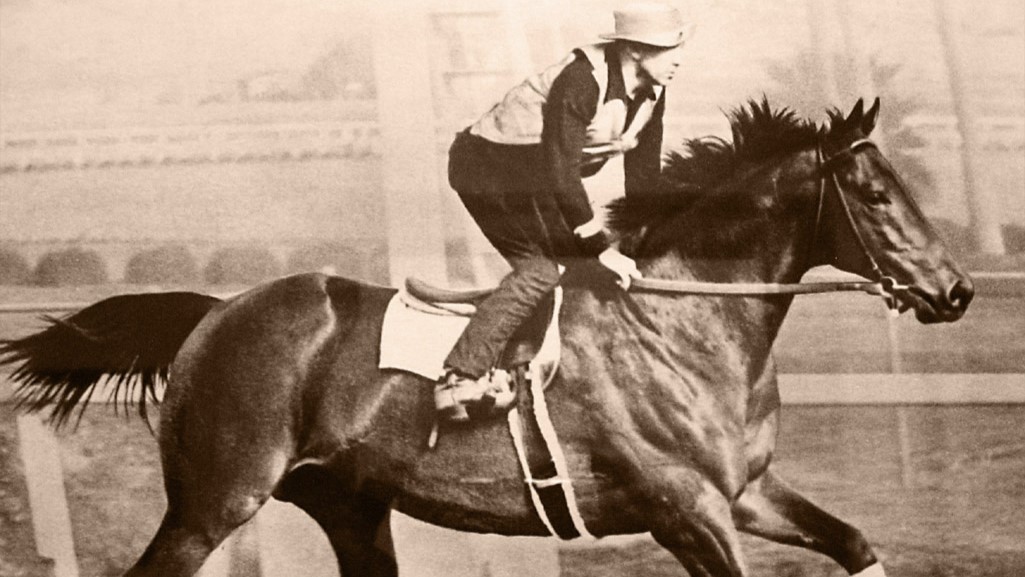
Seabiscuit was born on May 23, 1933, in Lexington, Kentucky. His sire was Hard Tack, a son of the legendary Man o’ War, and his dam was Swing On. Despite this impressive lineage, Seabiscuit was small and had knobby knees. He preferred sleeping and eating over training, leading many to dismiss his racing potential.
Initially, Seabiscuit was owned by Wheatley Stable and trained by “Sunny Jim” Fitzsimmons. Fitzsimmons, focusing on other horses, relegated Seabiscuit to a grueling schedule of minor races. The colt lost his first 17 races, often finishing far behind. By the end of his two-year-old season, he had raced 35 times with only five wins, leading many to consider him lazy and unremarkable.
Turning Point: New Ownership and Training
In 1936, automobile dealer Charles S. Howard purchased Seabiscuit for $8,000. Howard entrusted the horse to trainer Tom Smith, known for his unconventional methods and ability to rehabilitate discarded horses. Smith recognized Seabiscuit’s potential and began a unique training regimen to address the horse’s physical and psychological needs.
Smith provided Seabiscuit with high-quality hay and allowed him to rest as needed. He also created a comfortable environment by introducing companions like a calm horse named Pumpkin, a stray dog, and a spider monkey. This nurturing approach helped Seabiscuit relax and regain confidence.
Rise to Fame
With Smith’s training and jockey Red Pollard as his rider, Seabiscuit began to win races. In 1936, he secured victories in the Governor’s Handicap and the Scarsdale Handicap. The following year, he won prestigious races like the Brooklyn Handicap and the Massachusetts Handicap, breaking track records and earning substantial purses. Click for more info.
Seabiscuit’s success resonated with the American public during the Great Depression. His underdog story symbolized hope and resilience, making him a national hero. In 1938, he garnered more media coverage than President Franklin D. Roosevelt, highlighting his impact on the nation’s morale.
The Match of the Century
A highly anticipated match race between Seabiscuit and War Admiral, the 1937 Triple Crown winner, took place on November 1, 1938, at Pimlico Race Course in Baltimore. Despite being the underdog, Seabiscuit, ridden by jockey George Woolf, led from the start and defeated War Admiral by four lengths. This victory solidified Seabiscuit’s status as a champion and further endeared him to the public.
Overcoming Adversity
Seabiscuit faced significant challenges, including injuries that led to a temporary retirement in 1939. Similarly, jockey Red Pollard suffered severe injuries but remained determined to return to racing. Their shared resilience culminated in a triumphant comeback at the 1940 Santa Anita Handicap, where Seabiscuit, with Pollard as his jockey, won the race that had previously eluded them.
Legacy
Seabiscuit retired after the 1940 racing season as the all-time leading money earner, with total winnings of $437,730. He spent his retirement at Howard’s Ridgewood Ranch in California, where he became a tourist attraction, drawing over 50,000 visitors.
Seabiscuit passed away on May 17, 1947, leaving behind a legacy as one of the most remarkable racehorses in history.
His story has been immortalized in books and films, including Laura Hillenbrand’s “Seabiscuit: An American Legend” and its 2003 film adaptation. Seabiscuit’s tale continues to inspire as a testament to determination, resilience, and the power of second chances.