
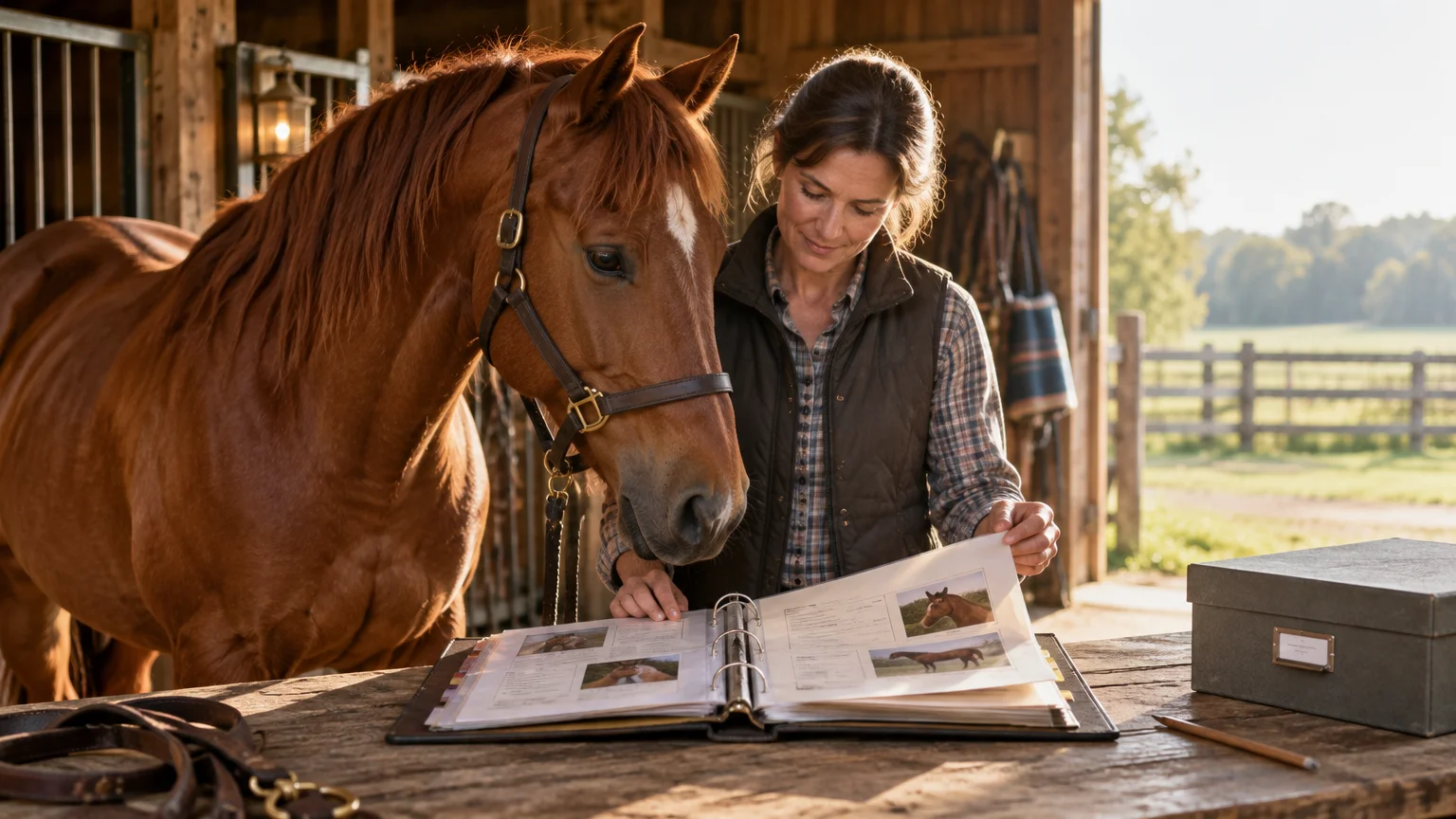
Small heritage horse populations need documentation that can answer four separate questions: Which individual horse is this? What ancestry is actually recorded? Has the horse contributed to the breeding population? Is the horse still living and included in the current count? A pedigree chart or registry certificate may answer part of that inquiry, but neither is a complete population record by itself.
This distinction matters because every record carries more weight in a small population. One horse counted twice can distort a total. A deceased horse left in an active file can make the living population appear larger. A prolific sire can make the number of registered foals look encouraging while concentrating ancestry within the next generation. Better documentation does not merely produce a tidier archive; it gives owners, breeders and conservation groups a clearer basis for decisions.
A headcount is only the beginning
The Food and Agriculture Organization’s guidance on surveying animal genetic resources recommends establishing a population baseline and repeating monitoring over time. The survey should record population size as well as factors, including crossbreeding, that may affect the integrity of the population being counted. That approach turns a one-time estimate into a record of change.
A useful annual count should have a stated reporting date and a defined scope. “Horses known to participating owners on December 31” is more meaningful than “about 100 horses.” The documentation should also explain whether the total includes foals, geldings, horses with incomplete pedigrees, animals outside the United States or horses recorded by more than one organization.
The living headcount, sometimes called census size, should not be confused with effective population size. Effective population size, or Ne, reflects how many animals are contributing genetically under a defined model. It is commonly smaller than the census count when breeding males and females contribute unequally or when a few animals produce a disproportionate share of the offspring. Inbreeding and coancestry are also useful conservation measures, although simple calculations rely on assumptions that real livestock populations may not satisfy. These figures deserve qualified analysis, not guesswork from a list of names.
Keep identity, ancestry and status in separate fields
Good documentation links several kinds of evidence without pretending that they are interchangeable. The APHIS equine identification guide lists markings, whorls, scars, brands, tattoos and electronic identification among the features that can help identify an individual horse. A microchip number or distinctive scar can connect paperwork to a physical horse, but it does not establish parentage, ownership or registry eligibility.
| Record layer | Question it answers | Useful evidence |
|---|---|---|
| Individual identity | Which physical horse does this record describe? | Microchip, brand or tattoo number; signalment; markings; whorls; scars; dated photographs |
| Recorded ancestry | Which parents and ancestors are supported by records? | Pedigree certificate, breeding report, parentage results and cited historical records |
| Registry status | Which organization recorded the horse, and when? | Registry name, registration number, status and issue date |
| Breeding contribution | Did this horse produce offspring in the documented population? | Mating records, foaling reports and offspring identifiers |
| Current population status | Should the horse be included in this reporting period? | Living or deceased status, last confirmed date, location and owner contact status |
| Provenance | Where did the horse and its records come from? | Breeder or agency history, transfer records, adoption papers and original document sources |
Owners can begin with a strong individual file. The site’s guide to combining microchips, photographs and written markings explains how multiple identifiers reinforce one another. For a Sulphur Mustang, the broader markings, history and ownership documentation workflow provides a practical structure for keeping identity and provenance together without confusing them with pedigree proof.
Multiple registries create a counting problem
Colonial Spanish horses include related strains, and multiple registries operate with differing goals. The Livestock Conservancy also notes that one horse may be registered with more than one registry. A population summary assembled by simply adding registry totals can therefore count the same animal twice.
Deduplication does not mean choosing one registry as the only legitimate source. It means retaining each registry attribution while assigning one stable population-record identifier to the horse. Alternate names, former names and spelling variations should remain searchable. Registration numbers should occupy separate fields rather than being combined into a note that later researchers must decipher.
The reporting rules should also state how uncertain records are handled. A horse with a documented identity but unresolved parentage can remain in the database with an “ancestry unconfirmed” flag. That is more honest and more useful than either excluding the horse without explanation or silently treating family tradition as verified pedigree.
Sulphur provenance requires careful wording
The Sulphur Herd Management Area is important to the history surrounding these horses, but origin, appearance and pedigree remain different categories. The Bureau of Land Management says some horses in the Sulphur HMA retain traits associated with Colonial Spanish horses while also noting that the herd has bred with escaped ranch livestock over time.
Accordingly, HMA origin, dun coloration, primitive markings or Colonial Spanish-type conformation can be recorded as provenance and description. Those characteristics alone do not document a private horse’s Sulphur-strain pedigree. The record should say exactly what the evidence supports: “removed from the Sulphur HMA,” “displays leg barring,” or “registered with a named organization” are distinct statements.
For a horse that passed through the federal wild horse program, the BLM freeze mark can help recover part of that history. The agency says the mark on the left side of the neck encodes a birth year and unique registration number; associated records may include origin, gather history, health information and adoption or sale details. That evidence supports public-land and agency provenance, but it does not by itself establish a private ownership chain, strain pedigree or genetic percentage.
What a repeatable population record should contain
A practical system does not have to begin with specialized conservation software. A carefully controlled spreadsheet or database can work if the fields are consistent, supporting files are preserved and changes are logged. Start with a data dictionary that defines what each field means and which values are allowed.
- Assign one stable population-record ID to each horse, independent of any registry number or name.
- Record registered names, barn names, previous names and spelling variants in separate searchable fields.
- Capture permanent identifiers and a written signalment, then link them to dated photographs.
- List each registry separately with its registration number, status, issue date and supporting document.
- Record sire and dam as claims tied to evidence, not merely as names typed into a pedigree box.
- Track sex, birth date or estimated year, living status, death date when known, and the date status was last confirmed.
- Record breeding contribution by linking each foal to both the individual horse and the evidence supporting parentage.
- Keep current custodian or owner contact information access-controlled rather than publishing personal details in a public census.
- Retain provenance for every imported record, including who supplied it, when it was received and whether it was copied from an original.
- Run a documented annual review and preserve each reporting snapshot instead of overwriting the previous total.
Historical material deserves the same care. When paper pedigrees, handwritten breeding books or old correspondence are scanned, preserve the original layout, marginal notes and source history. A transcription is useful for searching, but it should remain linked to the image from which it was made. The workflow for digitizing old pedigree charts without losing context is a sensible model for that part of the project.
A simple example of why the method matters
Imagine that three lists contain 42, 31 and 18 horse records. Adding them produces 91 entries, but that is not yet a population estimate. Suppose comparison of microchips, registration numbers, markings and ownership histories reveals 12 cross-listed horses. Five more records belong to deceased horses, and four have not been confirmed for several years.
The project should not leap from those observations to one unexplained total. It should report the result in layers: 79 unique records after known duplicates are resolved; 74 not recorded as deceased; and 70 with status confirmed within the chosen reporting window. The four unresolved records should remain visible as unresolved, not quietly included or deleted. This is a hypothetical example, but it shows why definitions and dates are as important as arithmetic.
Population status should not be reduced to a slogan
The Livestock Conservancy’s 2026 Conservation Priority List places both the Colonial Spanish horse and the Sulphur strain in its Critical category. For that list, Critical means fewer than 200 annual United States registrations and an estimated global population below 500. The classification is a conservation-status category, not a published census of every living Sulphur horse.
That difference should encourage better records rather than exaggerated certainty. Registration activity, estimated population, living census, breeding animals and effective population size are related measures, but they are not synonyms. Publishing the measure, date, scope and method alongside every total lets future readers understand what changed and what did not.
Start with one annual documentation cycle
Small heritage populations will always contain incomplete histories. The goal is not to make uncertainty disappear. It is to prevent uncertainty from being mistaken for fact and to preserve enough context for the next owner, breeder or historian to improve the record. Patient documentation gives a heritage population something memory alone cannot provide: a durable account of who the horses are, how they are related and how the population is changing.
References
- Surveying and monitoring of Animal Genetic Resources – Guidelines 7
- In vivo conservation of animal genetic resources
- NVAP Reference Guide: Equine Identification | APHIS
- Colonial Spanish Horse – The Livestock Conservancy
- Utah – Sulphur HMA | Bureau of Land Management
- Freeze Marks | Bureau of Land Management
- livestockconservancy.org